Search
The user submits a location through a validated search form.
Project / 03
A weather interface built around validated external data, explicit transformation and resilient UI states.
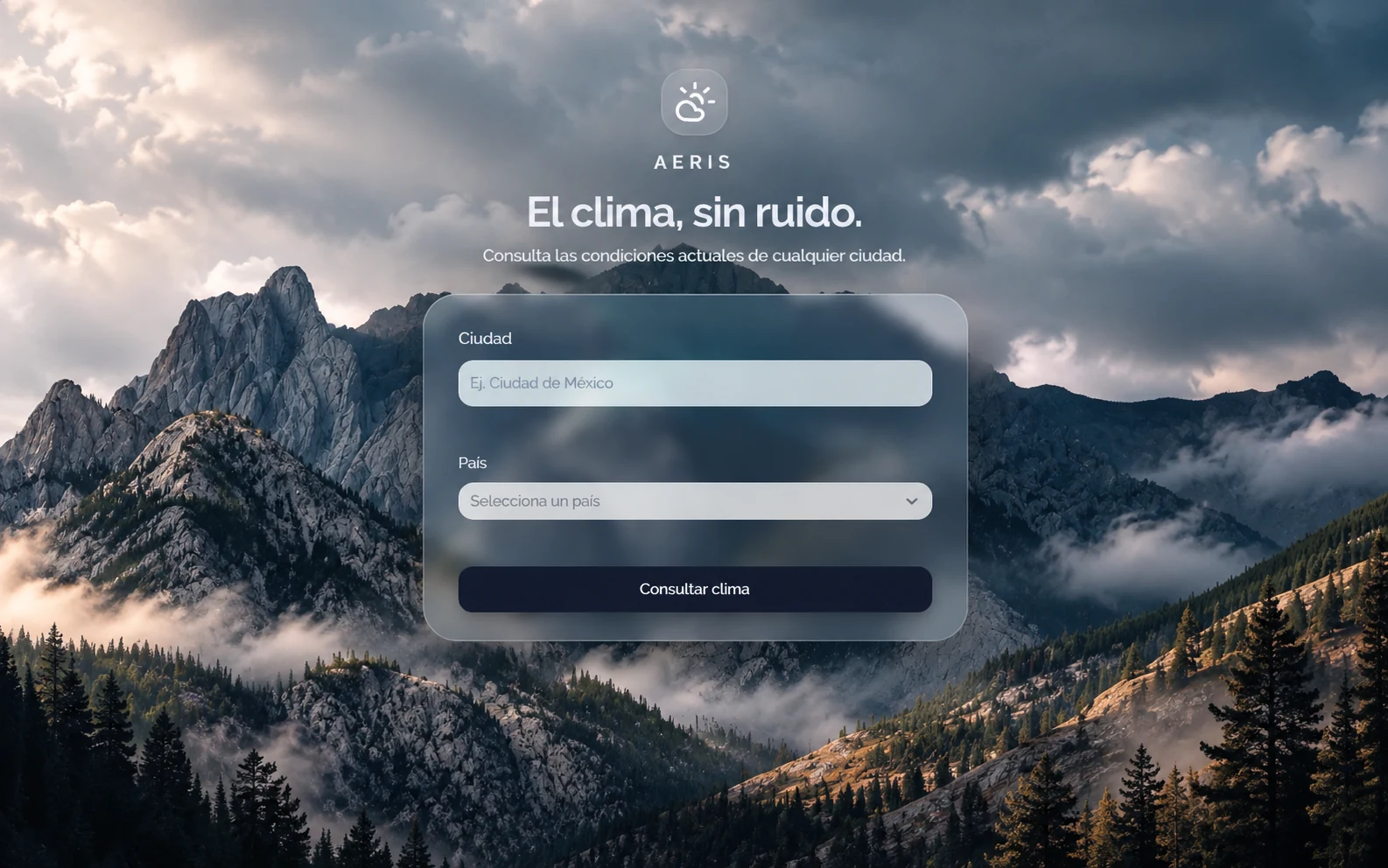
A responsive weather application that transforms external API data into a validated, predictable frontend data flow using React and TypeScript.
Project system
Aeris
Status
Completed
Domains
05
Knowledge Nodes
18
Cross-domain
08
01 / System Context
Aeris was built as a focused frontend engineering project around a deceptively simple problem: external weather data should never flow directly into the interface without an explicit validation and transformation boundary.
Problem
Weather APIs expose external data that cannot be trusted blindly. The project focused on building a clear boundary between remote data, validation, transformation and presentation while maintaining a polished responsive experience.
02 / Architecture
The application separates user input, external API access, runtime validation, adaptation, remote state and presentation. The UI consumes predictable application data instead of depending directly on third-party response shapes.
03 / Runtime Flow
The user submits a location through a validated search form.
The application resolves the location into coordinates through the external geocoding API.
External API responses are validated at runtime before becoming trusted application data.
Validated external data is transformed into an application-oriented representation.
TanStack Query manages asynchronous server state, caching and request lifecycle.
The final weather model is rendered through responsive and explicit UI states.
04 / Decisions
TypeScript only guarantees compile-time assumptions. Zod provides runtime validation at the exact boundary where untrusted API responses enter the application.
Adapters prevent external response structures from leaking through the entire component tree and reduce coupling to the API provider.
Remote weather data has a lifecycle fundamentally different from local UI state. Query state, caching and request status belong to a dedicated server-state abstraction.
The application uses the native Fetch API and isolates requests inside feature-level API functions instead of mixing network concerns with presentation.
05 / Knowledge Evidence
Engineering Domains
Validated Knowledge Nodes
1806 / Quality
Aeris was completed with automated component and behavior verification, repository quality tooling and a production deployment review.
Tests
17
Test files
05
Deployment
Vercel
Lighthouse
All green
Vitest + React Testing Library coverage for critical behavior
Runtime validation through Zod
ESLint and Prettier quality gates
Husky and lint-staged pre-commit automation
Production build and deployment validation
Responsive and loading-state verification
07 / Outcome
The final result is a deployed weather application whose main value is not only its interface, but the explicit data pipeline underneath it: external information is fetched, validated, transformed and consumed through predictable application boundaries.