Input
The user enters patient, owner, contact, date and symptom information through the form.
Project / 05
A focused React interface for veterinary patient management.
A frontend application for managing veterinary patient information, built with React and a lightweight Vite and Tailwind CSS stack.
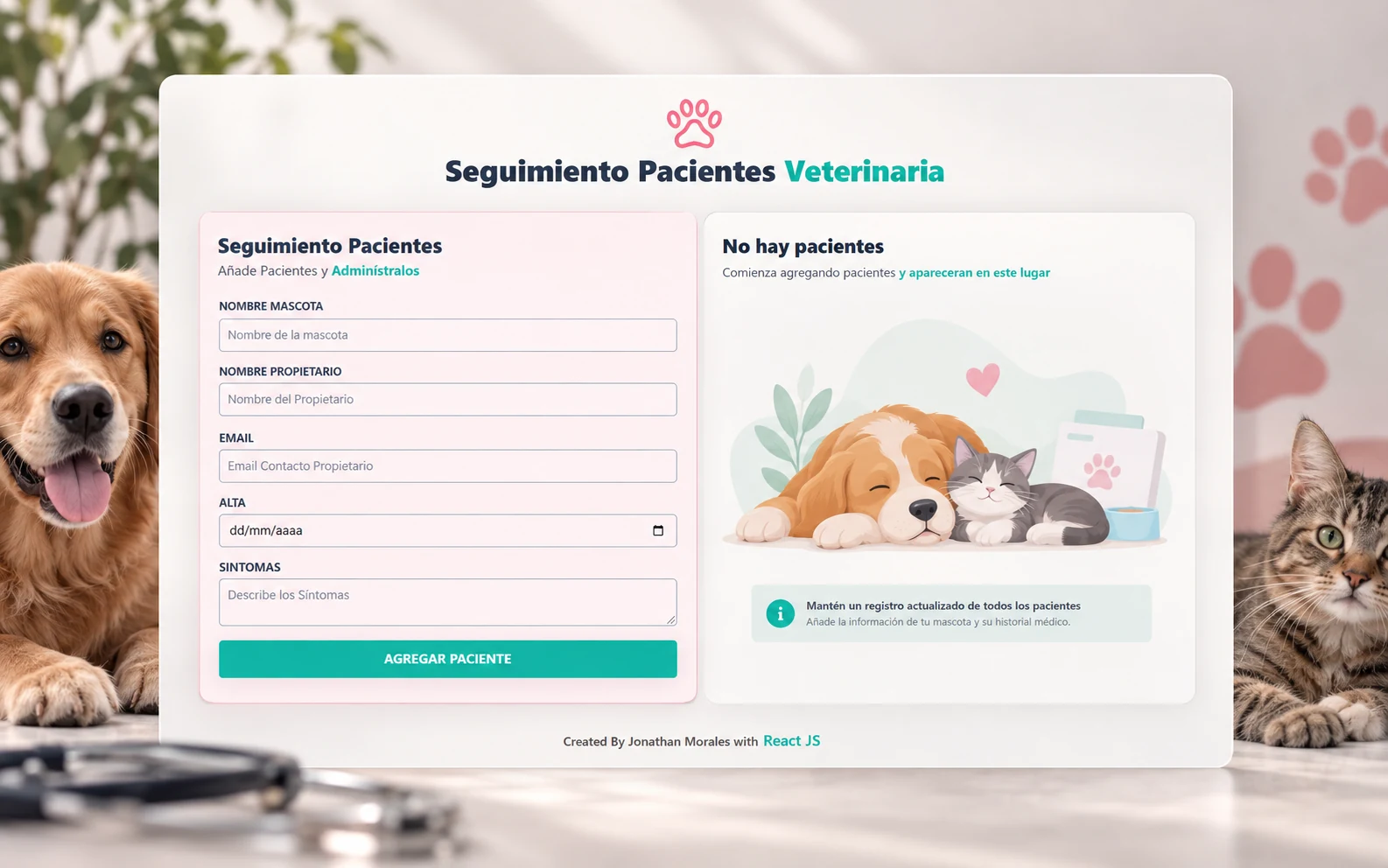
Project system
Veterinary Patients
Status
Completed
Domains
02
Knowledge Nodes
03
Cross-domain
01
01 / System Context
Veterinary Patients is an earlier React project focused on a straightforward patient-management workflow. It captures veterinary patient information through a controlled form and keeps the patient list synchronized with browser storage.
Problem
Veterinary patient information needed to be captured and presented through a simple, usable client-side interface.
02 / Architecture
The application uses local React state for patient records and the currently selected patient. Formulario manages creation and editing, ListadoPacientes renders the collection, Paciente exposes record actions and localStorage provides persistence across browser sessions.
03 / Runtime Flow
The user enters patient, owner, contact, date and symptom information through the form.
The form verifies that required fields are present before creating or updating a patient record.
React state owns the patient collection and the patient currently selected for editing.
New patients receive an identifier and existing records can be replaced through the editing flow.
The patient collection is serialized into localStorage whenever application state changes.
Records can be reviewed, edited or deleted through the patient list interface.
04 / Decisions
The scope of the project is intentionally small, so React state and localStorage provide enough infrastructure without introducing a backend.
Each patient field is represented explicitly in component state, making creation and editing behavior straightforward to follow.
Selecting an existing patient repopulates the form and allows the same workflow to handle both creation and updates.
Synchronizing the patients array with localStorage allows records to survive page reloads without requiring a server.
05 / Knowledge Evidence
Engineering Domains
Validated Knowledge Nodes
0306 / Quality
This project represents an earlier stage of the frontend progression and focuses on clear React fundamentals rather than a larger infrastructure or testing system.
Frontend
React 18
Build
Vite 4
Persistence
LocalStorage
Styling
Tailwind 3
Controlled React forms
Required-field validation
Create and edit flows
Patient deletion
localStorage synchronization
Responsive patient-management layout
07 / Outcome
The final application provides a complete client-side patient workflow covering creation, validation, persistent storage, editing, listing and deletion while demonstrating the React fundamentals that preceded the more architecturally complex projects in the portfolio.